Bad Muskau and Muskau Park: A Cross-Border Route Between Germany and Poland for a Slow Journey
Bad Muskau and Muskau Park form one of the most distinctive cultural landscapes in Central Europe, where geography, history, and careful landscape design meet along the German–Polish border. This route is not about speed or checklist tourism. Instead, it rewards those who prefer unhurried travel, allowing time to notice subtle changes in scenery, architecture, and atmosphere as you move between two countries within a single park.
The Historical Context of Muskau Park and Its Cross-Border Identity
Muskau Park, a UNESCO World Heritage Site, was created in the early 19th century by Prince Hermann von Pückler-Muskau, a landscape designer whose vision extended far beyond decorative gardens. He aimed to reshape the natural terrain into a seamless composition, blending rivers, meadows, and forested areas into a coherent visual experience. Today, this vision remains intact, even though the park is divided between Germany and Poland.
The division of the park occurred after the Second World War, when the Lusatian Neisse River became part of the border between the two countries. Despite this political separation, the park has been preserved as a unified cultural site. Visitors can cross the border freely on foot or by bicycle, often without noticing any abrupt change in landscape design.
Bad Muskau, on the German side, serves as the main gateway to the park. It offers restored buildings, visitor centres, and access points that help interpret the historical significance of the area. On the Polish side, Łęknica provides quieter entry points and access to more natural, less structured parts of the park, which appeal to those seeking a more relaxed experience.
Why Muskau Park Is Different from Traditional European Gardens
Unlike formal gardens found in France or Italy, Muskau Park follows the principles of English landscape design. This means that symmetry and strict geometry are replaced with flowing lines, open vistas, and carefully framed views that appear natural rather than constructed.
The park is designed to be experienced in motion. Walking or cycling reveals changing perspectives, with paths leading through wooded areas, across open lawns, and towards architectural focal points such as bridges and the New Castle. Each section unfolds gradually, encouraging a slower pace.
This approach makes Muskau Park particularly suitable for travellers who prefer immersive experiences. Rather than focusing on individual landmarks, the emphasis is on the journey itself and the subtle transitions between spaces.
Planning a Slow Travel Route Through Bad Muskau and Beyond
A well-planned route through Muskau Park begins in Bad Muskau, where infrastructure is more developed. From here, visitors can hire bicycles, access maps, and gather practical information. The town itself is compact, making it easy to navigate without rushing.
The most effective way to explore the park is by combining walking and cycling. Cycling allows you to cover larger distances, while walking sections provide the opportunity to appreciate finer details such as tree compositions, water reflections, and historical structures.
Crossing into Poland is straightforward via several pedestrian and cycling bridges. There are no border controls within the park area, which allows for a continuous experience. This fluid movement between countries adds a unique dimension to the journey, especially for those interested in European border regions.
Key Stops Along the Route Worth Including
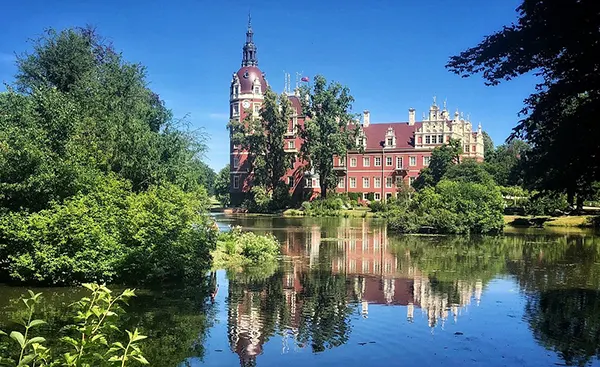
The New Castle (Neues Schloss) is one of the central landmarks on the German side. Although reconstruction work has taken place over the years, it remains a focal point for understanding the scale and ambition of the original design.
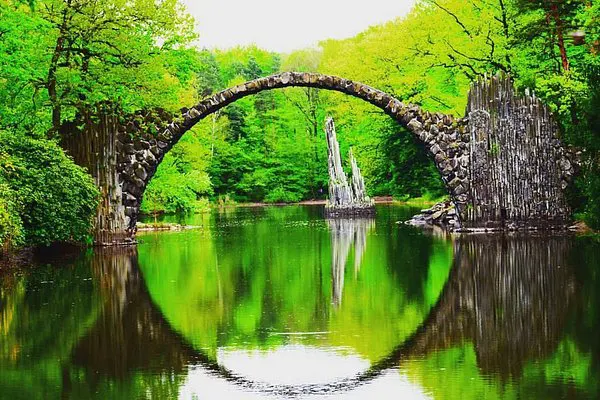
The English Bridge and Double Bridge are notable for their visual composition. They are positioned to create balanced views across the river, illustrating how architecture and landscape were integrated into a single concept.
On the Polish side, the arboretum and forested areas provide a quieter contrast. These sections are less structured but offer a deeper connection with nature, particularly for those interested in botanical diversity and seasonal changes.
Practical Tips for Visiting in 2026
As of 2026, Muskau Park continues to be well maintained on both sides of the border, with ongoing restoration projects focusing on historical accuracy. Visitors should check current information regarding access to specific buildings, as some areas may still be undergoing conservation work.
Spring and early autumn are considered the best times to visit. During these periods, the park’s colour palette changes significantly, and temperatures are comfortable for extended walks or cycling routes. Summer can be pleasant but may attract more visitors, particularly on weekends.
Accommodation options are available in Bad Muskau and nearby towns, ranging from small guesthouses to boutique hotels. Staying overnight allows for a more relaxed itinerary, avoiding the need to rush through the park in a single day.
What to Keep in Mind for a Comfortable Experience
Footwear is important, as paths vary between paved routes and natural trails. Comfortable walking shoes are recommended, especially if you plan to explore both sides of the park in one visit.
Bring water and light food, particularly if you intend to spend several hours inside the park. While there are cafés and rest areas, they may be spaced apart, especially on the Polish side.
Finally, allow flexibility in your schedule. Muskau Park is best appreciated without strict time constraints, giving you the freedom to pause, observe, and adapt your route based on what captures your interest along the way.