Görlitz: Germany’s Film Town with a Preserved Old Centre and Unusual Routes
Görlitz, located on Germany’s eastern border with Poland, has quietly built a reputation as one of Europe’s most visually authentic historic towns. Its remarkably preserved architecture, combined with a growing role in international cinema, makes it a destination that balances cultural depth with practical travel value. For visitors in 2026, the city offers not only postcard streets but also lesser-known routes that reveal its layered identity beyond the usual sightseeing paths.
Why Görlitz Became a Film Location of European Importance
Over the past two decades, Görlitz has been selected as a filming location for numerous international productions, including “The Grand Budapest Hotel”, “Inglourious Basterds”, and “The Reader”. Directors choose the city because its buildings span several historical periods without heavy modern alterations. This allows production teams to recreate different eras without extensive digital modification.
The local authorities have actively supported film projects through streamlined permits and logistical assistance. As a result, the town earned the nickname “Görliwood”, reflecting its growing recognition in the European film industry. This cooperation has also contributed to local economic development, especially in tourism and hospitality sectors.
For travellers, this cinematic connection translates into themed walking routes that highlight filming locations. These routes are well-marked and often include contextual information about specific scenes, making them accessible even for visitors without prior knowledge of the films.
How Film Tourism Shapes the Visitor Experience
Film tourism in Görlitz is structured rather than commercialised. Instead of large attractions, the city integrates film-related points into its existing urban environment. Visitors encounter locations naturally while walking through the old town, rather than visiting isolated exhibition spaces.
Guided tours are available in multiple languages, including English and German, and often combine film history with architectural insights. This dual focus adds depth, as visitors understand not only where scenes were filmed but also why these locations were suitable.
Importantly, the film identity does not overshadow the city’s historical character. Görlitz maintains a balanced narrative, where cinema enhances rather than replaces its cultural heritage.
The Old Town: One of the Best Preserved in Central Europe
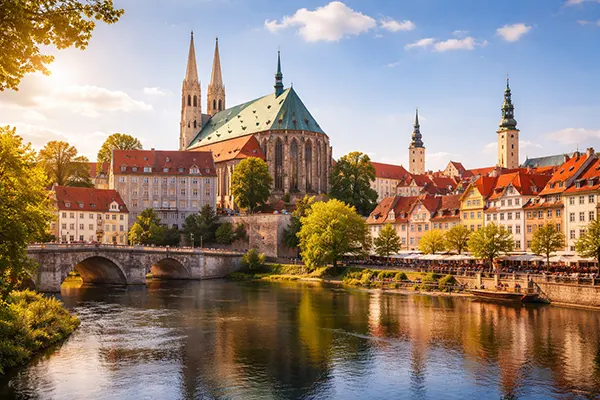
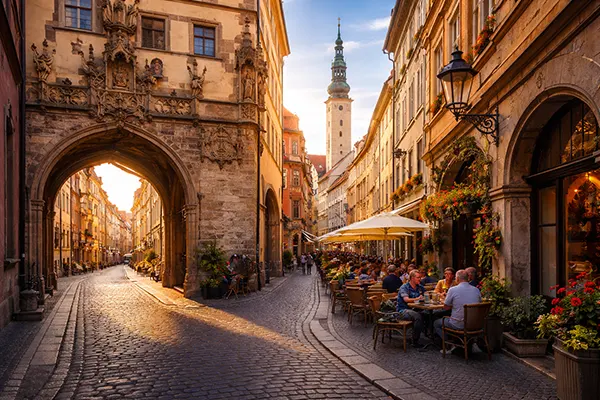
Görlitz’s old town is widely considered one of the most intact historic centres in Germany. Unlike many cities affected by World War II destruction, Görlitz retained a large proportion of its original buildings, ranging from Gothic to Renaissance and Baroque styles.
The Untermarkt and Obermarkt squares form the core of the old town. Here, visitors can observe detailed façades, arcades, and townhouses that reflect centuries of urban development. Restoration efforts since the 1990s have been extensive, often funded through a combination of public investment and private donations.
Crossing the Neisse River leads to Zgorzelec, the Polish side of the city. This cross-border dynamic offers a rare opportunity to experience two cultural contexts within a short walking distance, adding practical value to a visit.
Architectural Details Worth Noticing
Beyond the main squares, Görlitz reveals its character through smaller details. Doorways, courtyards, and staircases often feature original craftsmanship that has been preserved or carefully restored. These elements are easy to miss without a slower, more attentive pace of exploration.
Churches such as St. Peter and Paul display both religious significance and architectural diversity. Their interiors provide insight into regional artistic traditions and historical influences from neighbouring regions.
For those interested in urban planning, Görlitz offers a clear example of how historical continuity can be maintained without turning a city into a static museum. Everyday life continues within these spaces, making the experience more authentic.
Alternative Routes Beyond the Standard Tourist Map
While the old town attracts most visitors, Görlitz also offers alternative routes that provide a different perspective. These include industrial heritage sites, green spaces along the river, and residential districts that reflect 19th-century expansion.
The Landeskrone hill, located just outside the centre, offers panoramic views and a chance to understand the city’s geographical layout. It is accessible by foot or public transport, making it a practical addition to a one- or two-day itinerary.
Another lesser-known area is the Gründerzeit district, where large residential buildings showcase the economic growth of the late 19th century. This part of the city contrasts with the medieval core and highlights Görlitz’s development during the industrial era.
Planning a Balanced Itinerary in 2026
For a short visit, a combination of the old town and one alternative route provides a well-rounded experience. Starting with the central squares and then moving towards either the riverbank or the Gründerzeit district allows for a logical flow without excessive travel time.
Public transport in Görlitz remains reliable and affordable, with updated schedules and digital ticketing options available as of 2026. Walking is still the most efficient way to explore the historic centre, while bicycles are useful for reaching outer areas.
Seasonal factors should also be considered. Spring and early autumn offer the most comfortable conditions for walking routes, while winter highlights the architectural atmosphere but may limit access to some outdoor viewpoints.